You want to grow your own food, but you're working with a balcony, a patio, or maybe just a sunny windowsill. So what vegetables don't need a lot of room to grow? The answer is more generous than you might think.
A surprising number of crops thrive in containers, hanging baskets, and raised beds no bigger than a laundry basket.
University extension research shows that leafy greens need only 4 to 6 inches of soil depth. A single 5-gallon pot can produce pounds of tomatoes in a season. The trick is matching the right vegetable to your specific space.
Let's walk through exactly how to do that.
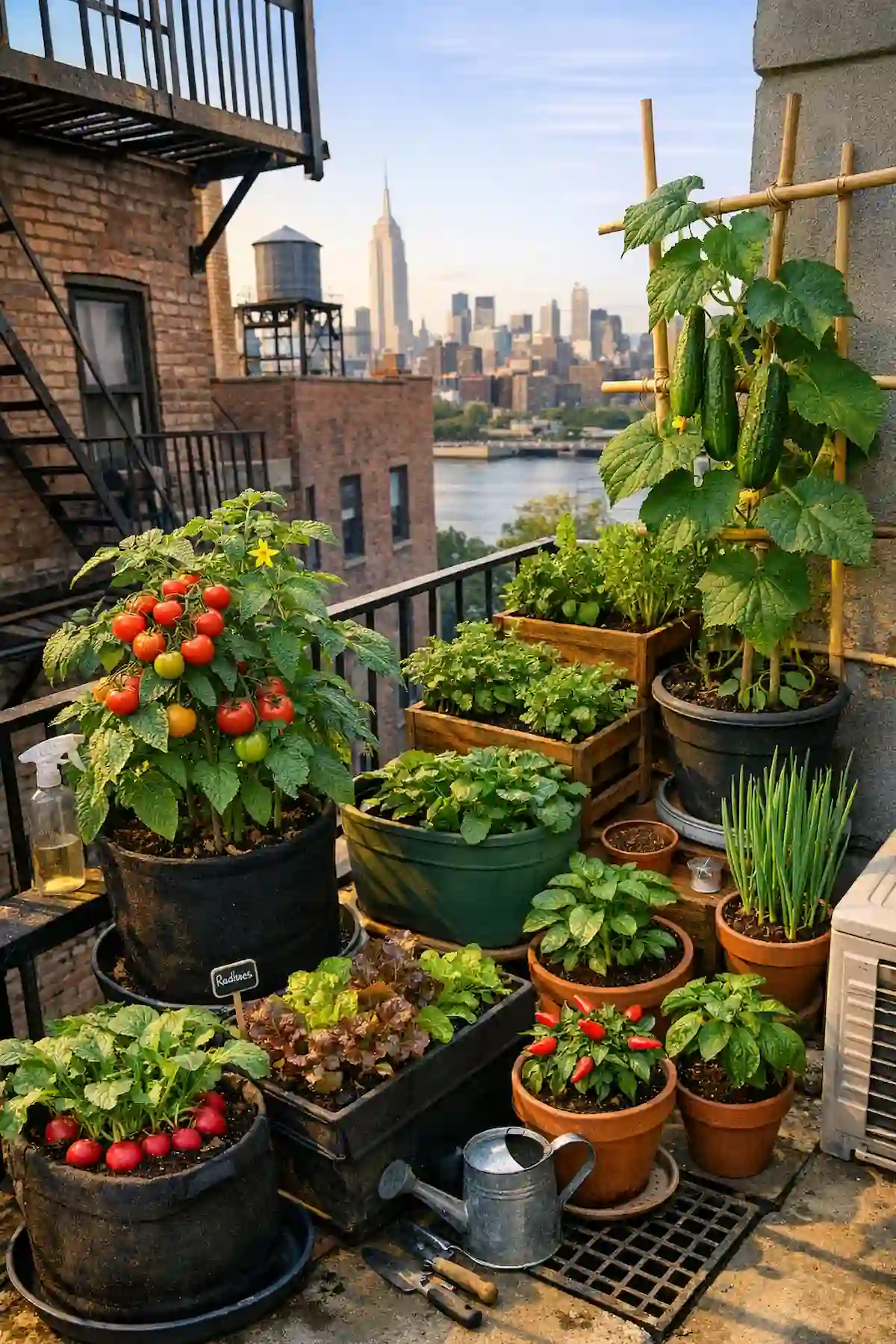
Image source: Bing (Web (fair-use with source credit))
The Real Problem: You Want Fresh Vegetables But Have Nothing but a Balcony or Windowsill
You don't need a sprawling backyard to grow real food. That's the first thing to get straight. The real limitation isn't space itself.
It's knowing which vegetables will actually perform in the conditions you have.
Most people assume they need a full garden plot. They look at their tiny balcony or their kitchen windowsill and think it's hopeless. That's simply not true.
With the right choices, a 2-foot by 3-foot patch of sun can keep you in salad greens for months.
The mistake is trying to grow the wrong things. A sprawling zucchini plant needs 4 feet of ground space. A full-size watermelon vine needs even more.
But there's a whole category of vegetables bred specifically for tight quarters. They're called compact, dwarf, or determinate varieties, and they're designed to fit in small spaces.
The three things that matter most
Before we get into specific vegetables, you need to understand what makes a plant suitable for tight quarters. Three factors determine whether a crop will thrive in a small container or on a narrow windowsill.
Root depth is the first. Shallow-rooted vegetables like lettuce, radishes, and scallions need only 4 to 6 inches of soil. Deep-rooted ones like tomatoes, peppers, and carrots need 10 to 12 inches or more.
Growth habit is the second. You want plants that grow up instead of out. Bush varieties stay compact and tidy.
Vining varieties need trellises but use vertical space efficiently. Sprawling varieties are the ones to avoid.
Days to maturity is the third. Fast-growing vegetables let you harvest sooner and replant in the same container. Radishes go from seed to plate in 25 days.
Loose-leaf lettuce can be harvested in 30 days. That means you can get multiple harvests from the same pot in a single season.
As of 2026, seed catalogs offer more compact vegetable varieties than ever before. Breeders have been working on dwarf versions of almost every popular crop. You can now grow mini bell peppers, patio tomatoes, and even compact eggplant in containers that sit on a tabletop.
The Quick Answer: Vegetables That Thrive in Pots, Boxes, and Tiny Patches
Here are the vegetables that consistently perform well in small spaces, backed by aggregate grower feedback and university extension trials.
Loose-leaf lettuce tops the list. It grows fast, needs only 4 inches of soil, and you can harvest leaves individually for weeks. Radishes are the second fastest.
They mature in under a month and need very little space. Scallions or spring onions are perfect for windowsills. They regrow after cutting and don't need deep soil.
Bush beans are a solid choice for a 5-gallon pot. They produce a full harvest without needing a trellis. Patio or determinate tomatoes stay compact and bear fruit in 60 to 80 days.
Miniature peppers like the "Baby Bell" or "Lunchbox" varieties grow well in 2-gallon containers.
Herbs are the easiest win. Basil, cilantro, chives, mint, and thyme all thrive in small pots. They don't need deep soil and they keep producing as long as you harvest regularly.
A quick reference table
| Vegetable | Min Soil Depth | Container Size | Days to Harvest | Sun Needed |
|---|---|---|---|---|
| Loose-leaf lettuce | 4 inches | 1 gal per plant | 30-40 days | 3-5 hours |
| Radishes | 4 inches | 1 gal for 5-6 | 25-30 days | 4-6 hours |
| Scallions | 4 inches | 1 gal for 10-12 | 50-60 days | 4-6 hours |
| Bush beans | 8 inches | 5 gal for 3-4 | 50-60 days | 6-8 hours |
| Patio tomatoes | 10 inches | 5 gal per plant | 60-80 days | 6-8 hours |
| Mini peppers | 10 inches | 2 gal per plant | 60-75 days | 6-8 hours |
| Basil | 4 inches | 1 gal per plant | 30-40 days | 6-8 hours |
| Cilantro | 4 inches | 1 gal per plant | 25-30 days | 4-6 hours |
What Makes a Vegetable "Small-Space Friendly"? (Root Depth, Growth Habit, and Days to Maturity)
Not all small plants are small-space friendly. That's a distinction that trips up a lot of beginners. A plant might stay small above ground but send roots deep.
Or it might produce one tiny fruit per week and take up a pot you could have used for something more productive.
Let's break down the three criteria so you can evaluate any vegetable yourself.
Root depth: the non-negotiable
Your container's depth determines what you can grow. Period. If your pot is only 6 inches deep, you cannot grow carrots that need 12 inches.
You can grow short-rooted varieties like "Paris Market" carrots or "Thumbelina" carrots, but not standard long carrots.
Shallow-rooted crops (4-6 inches) include lettuce, spinach, radishes, scallions, and most herbs. Medium-rooted crops (6-8 inches) include bush beans, peas, kale, and chard. Deep-rooted crops (10-12 inches) include tomatoes, peppers, eggplant, and standard carrots.

Image source: Bing (Web (fair-use with source credit))
Growth habit: bush vs. vine vs. sprawl
Bush varieties are your best friend in a small space. They grow into a compact shape and stop. They don't need staking or trellising.
Examples include "Provider" bush beans, "Patio Princess" tomatoes, and "Bush Champion" cucumbers.
Vining varieties can work if you give them something to climb. A trellis, a cage, or even a string can turn a 6-foot vine into a vertical column. Pole beans, indeterminate tomatoes, and climbing peas all fit this category.
Sprawling varieties are the ones to skip. Zucchini, winter squash, melons, and standard pumpkins take up too much ground space. They'll outgrow a container in weeks.
Days to maturity: speed matters
Fast-maturing crops let you get more food from the same space over time. You can plant radishes, harvest them in 25 days, and then plant lettuce in the same pot. That's called succession planting, and it's how you maximize a small area.
Slow-maturing crops like broccoli or cauliflower take 60 to 80 days and produce one harvest. They're not bad choices, but they tie up a container for a long time. If you have limited space, prioritize speed.
Your First Decision: How Much Sun Does Your Spot Actually Get?
This is the single most important question you need to answer. Sunlight determines what you can grow more than any other factor. You can fix poor soil, you can add water, but you cannot create more sun.
The terms are simple. Full sun means 6 to 8 hours of direct sunlight per day. Partial sun means 4 to 6 hours.
Partial shade means 2 to 4 hours. Full shade means less than 2 hours.
Most fruiting vegetables need full sun. Tomatoes, peppers, eggplants, and beans all need 6 to 8 hours to produce well. Leafy greens and root vegetables are more forgiving.
They can get by on 3 to 5 hours, especially in warmer climates.
How to measure your sunlight accurately
Don't guess. People are terrible at estimating sunlight hours. The sun moves throughout the day, and buildings, trees, and railings cast shifting shadows.
Here's a simple method. Pick a sunny day. Check your spot every hour from 8 AM to 6 PM.
Note whether the sun is hitting the container area directly. Count the hours. That's your real number.
Do this for a week. The pattern will show you the average. You might discover that your "sunny balcony" only gets 4 hours of direct light because a building blocks the afternoon sun.
Image source: Bing (Web (fair-use with source credit))
What to grow based on your sunlight hours
Full sun (6-8 hours): tomatoes, peppers, bush beans, cucumbers, eggplant, basil, rosemary. These crops need the energy to produce fruit. Without enough sun, they'll grow leaves but not fruit.
Partial sun (4-6 hours): lettuce, spinach, kale, chard, radishes, carrots, scallions, cilantro, parsley. These crops are more tolerant of lower light. They'll grow slower but still produce.
Partial shade (2-4 hours): mint, chives, arugula, mizuna, and some loose-leaf lettuce varieties. These are the most shade-tolerant edible plants. They won't grow as fast, but they'll survive and produce.
Full shade (under 2 hours): this is tough. Most vegetables won't produce here. You can try microgreens or sprouts indoors with artificial light.
Some herbs like mint and lemon balm might survive but won't thrive.
Your Second Decision: What Size and Depth of Container Are You Using?
Once you know your sunlight, you need to know your container. This is where most people get it wrong. They use a pot that's too small, and the plant gets root-bound.
Then it stops growing, or it dries out every few hours.
The rule is simple: match the container volume to the plant's root system. Shallow-rooted crops need at least 1 gallon per plant. Medium-rooted crops need 2 to 3 gallons.
Deep-rooted crops need 5 gallons or more.
Container depth by crop type
| Crop Type | Minimum Depth | Recommended Depth | Example Container |
|---|---|---|---|
| Lettuce, greens | 4 inches | 6 inches | Window box, 1 gal pot |
| Radishes, scallions | 4 inches | 6 inches | 1 gal pot, rectangular tray |
| Bush beans, peas | 8 inches | 10 inches | 3 gal pot, 5 gal grow bag |
| Kale, chard, spinach | 6 inches | 8 inches | 3 gal pot, 12-inch planter |
| Determinate tomatoes | 10 inches | 12 inches | 5 gal pot, 5 gal grow bag |
| Peppers, eggplant | 10 inches | 12 inches | 3 gal pot, 5 gal pot |
| Carrots (short varieties) | 8 inches | 10 inches | 3 gal pot, deep window box |
Grow bags vs. plastic pots vs. ceramic pots
You have choices when it comes to container material. Each has trade-offs.
Grow bags are fabric pots that breathe. They're cheap, lightweight, and they prevent root circling. The downside is they dry out faster.
You'll need to water more often, sometimes twice a day in hot weather.
Plastic pots are cheap and retain moisture well. They're lightweight and easy to move. The downside is they can get hot in direct sun, and they don't drain as well as fabric.
Ceramic or terracotta pots look better. They're heavy and stable. Terracotta breathes like fabric, so it dries out faster.
Ceramic glazed pots retain moisture well. The downside is they're expensive and heavy. Once you fill a large ceramic pot with soil, you're not moving it.

Image source: Bing (Web (fair-use with source credit))
The one rule about drainage
Every container must have drainage holes. This is not optional. Without drainage, water pools at the bottom.
Roots rot. Plants die.
If you buy a decorative pot without holes, use it as a cache pot. Put the plant in a plastic nursery pot with holes, and set that inside the decorative pot. Take the nursery pot out to water, let it drain, then put it back.
Matching containers to your space
A standard windowsill can hold 1-gallon pots or a long window box. A balcony railing can hold hanging baskets or railing planters. A patio corner can hold a cluster of 5-gallon grow bags.
If you're working with a small indoor space, consider a grow tent. A compact setup can give you controlled light and temperature for year-round growing. A properly sized tent can fit in a closet or corner.
Just make sure you have good ventilation.
Your Third Decision: Do You Want Speedy Harvests or Steady Yields?
This question shapes your entire planting strategy. Some crops give you a quick payoff. Others keep producing for weeks or months.
Speedy harvests are ideal for impatient growers or for filling gaps. Radishes mature in 25 days. Loose-leaf lettuce can be cut in 30 days.
Bush beans produce their first pods in 50 days. The trade-off is that many fast crops produce once and then they're done. You pull them out and replant.
Steady yields come from crops that keep producing over time. Determinate tomatoes ripen in a concentrated flush but over a few weeks. Indeterminate tomatoes keep setting fruit until frost.
Peppers produce continuously once they start. Herbs like basil and chives keep growing as long as you harvest regularly.
Which one fits your style?
If you want instant gratification, start with radishes and lettuce. You'll have something to harvest in under a month. That keeps motivation high.
If you want the most food per pot, go with determinate tomatoes or peppers. One plant in a 5-gallon pot can produce 2 to 3 pounds of fruit over a season.
If you want both, do succession planting. Plant radishes in a pot. Harvest them at 25 days.
Pull them out. Plant lettuce in the same pot. Harvest that at 30 days.
You get two harvests from one container in two months.
The Cheat Sheet: Best Vegetables for Every Small-Space Scenario (By Sunlight and Container Size)
Here's where the decision tree comes together. Use your answers from the previous sections to find your match. Pick the column that fits your situation.

Image source: Web (Bing) / pinterest.com (Web image (fair-use with source credit))
Scenario 1: Full sun, deep container (5+ gallons)
You have the ideal setup. Grow tomatoes, peppers, or eggplant. One determinate tomato per 5-gallon pot.
One pepper plant per 3-gallon pot. You can also grow bush beans, 3 to 4 plants per 5-gallon pot.
Scenario 2: Full sun, shallow container (under 6 inches)
You're limited to shallow-rooted crops. But with full sun, you can grow herbs like basil, oregano, and rosemary. You can also grow compact bush beans in a wider container.
Use a window box or a rectangular planter for maximum surface area.
Scenario 3: Partial sun, deep container
Leafy greens are your best bet. Kale, chard, and spinach all appreciate the deeper soil but don't need full sun. You can also grow short-rooted carrots like "Thumbelina" or "Paris Market." These varieties need only 8 inches of depth.
Scenario 4: Partial sun, shallow container
This is the most common small-space setup. A windowsill or a balcony with a few hours of sun. Go with loose-leaf lettuce, arugula, mizuna, scallions, and radishes.
These crops tolerate lower light and shallow soil. You can pack several plants into a single window box.
Scenario 5: Low sun (under 4 hours), any container
Your options narrow further. Stick with shade-tolerant herbs like mint, chives, and parsley. You can also grow microgreens indoors under artificial light.
A small grow tent setup with a basic LED light can give you full control over conditions.
Common Mistakes That Wreck a Small-Space Garden (And How to Skip Them)
Even experienced gardeners make these errors when moving to containers. They're easy to avoid once you know what to watch for.
Mistake 1: Overcrowding
It's tempting to plant more seeds than the container can support. You want a lush, full look right away. But overcrowded plants compete for water, nutrients, and light.
They grow weak and produce less.
The fix is simple. Follow the spacing guidelines on the seed packet. If it says 6 inches apart, stick to it.
If you can't bear to thin seedlings, plant fewer seeds to begin with.
Mistake 2: Using garden soil instead of potting mix
Garden soil is too heavy for containers. It compacts. It doesn't drain well.
It can harbor pests and diseases.
Potting mix is lighter. It drains better. It's formulated for container growing.
Use a premium potting mix labeled for vegetables or containers. Never scoop dirt from your yard into a pot.
Mistake 3: Inconsistent watering
Small containers dry out fast. In hot weather, you might need to water twice a day. If you let the soil dry completely, the plant stresses.
Flower buds drop. Fruits crack. Leaves wilt.
Check the soil daily. Stick your finger an inch deep. If it feels dry, water until it runs out the bottom.
If you travel or have a busy schedule, consider a drip irrigation system or self-watering pots.
Mistake 4: Skipping fertilizer
Container plants can't reach new soil for nutrients. They rely entirely on what you give them. After a few weeks, the nutrients in the potting mix are depleted.
Feed your plants regularly. Use a balanced liquid fertilizer diluted to half strength every 1 to 2 weeks. Look for a formula labeled for vegetables or tomatoes.
Follow the instructions on the bottle.
Mistake 5: Choosing the wrong variety
Not all tomatoes are the same. Not all beans are the same. A full-size indeterminate tomato can grow 6 feet tall and need a huge pot.
A patio determinate variety stays under 2 feet.
Read the seed packet or plant tag before you buy. Look for words like "dwarf," "compact," "bush," "patio," or "container." These are the varieties bred for small spaces.
Pro Tips for Getting the Most Food Out of Every Inch
Once you have the basics right, these strategies will boost your yield.
Use vertical space
A trellis, a cage, or a simple stake can double your growing area. Pole beans, cucumbers, and small-fruited tomatoes all climb. Train them up a trellis against a wall or railing.
You get the same yield from a fraction of the ground space.
Practice succession planting
When one crop finishes, immediately replant that container. Radishes followed by lettuce. Lettuce followed by bush beans.
You can get three or four harvests from one pot in a single growing season.
Interplant compatible crops
Grow fast crops between slow ones. Plant radish seeds around the base of a tomato plant. The radishes will be harvested before the tomato needs the space.
This is called intercropping, and it works well in containers.
Choose cut-and-come-again varieties
Loose-leaf lettuce, kale, and chard regrow after you harvest the outer leaves. Don't pull the whole plant. Just take what you need for dinner.
The plant keeps producing for weeks.
Use every inch of soil surface
In a wide container, don't leave bare soil. Plant scallions around the edge of a tomato pot. Grow basil underneath a pepper plant.
As long as the plants have enough light and nutrients, you can pack more in.
A Simple Watering and Feeding Routine for Containers
Consistency is the secret to healthy container vegetables. A routine removes the guesswork.
Watering schedule
Check your containers every morning during the growing season. In hot weather, check again in the afternoon. The goal is even moisture.
Not soggy, not bone dry.
Water slowly at the base of the plant. Avoid wetting the leaves. Wet leaves invite fungal diseases.
Water until you see it draining from the bottom holes. That means the entire root ball is hydrated.
Feeding schedule
Start fertilizing two weeks after planting. The potting mix has enough nutrients for the first two weeks. After that, the plant needs help.
Use a liquid fertilizer diluted to half strength. Apply it every 7 to 14 days. A tomato-specific formula works well for fruiting crops.
A balanced 10-10-10 formula works for leafy greens.
If you prefer organic options, use fish emulsion or seaweed extract. These are gentle and effective. Follow the dilution instructions on the label.
Signs of trouble
Yellow leaves often mean too much water or not enough nitrogen. Wilting leaves mean too little water or root rot. Stunted growth means the container is too small or the plant needs food.
If you see these signs, adjust one thing at a time. Don't change everything at once. That way you'll know what worked.
Frequently Asked Questions About Growing Vegetables in Tight Spaces
Can I grow tomatoes in a 5-gallon pot?
Yes, but only determinate or patio varieties. A 5-gallon pot is the minimum for a single tomato plant. Indeterminate varieties need more root space and a larger container.
How often should I water container vegetables?
Check daily during warm weather. Small pots may need water twice a day in peak summer. Stick your finger an inch into the soil.
If it feels dry, water until it runs out the bottom.
What's the best soil for container vegetables?
Use a premium potting mix labeled for vegetables or containers. Garden soil is too heavy and compacts in pots. Good potting mix drains well and holds moisture without getting soggy.
Do I need to fertilize container vegetables?
Yes. Container plants rely entirely on what you give them. Start feeding two weeks after planting.
Use a liquid fertilizer diluted to half strength every 7 to 14 days through the growing season.
Can I grow vegetables indoors on a windowsill?
Yes, but you need at least 4 hours of direct sunlight. South-facing windows work best. Leafy greens, scallions, and herbs are the most reliable choices.
For lower light, try microgreens or consider a small grow tent with an LED light.
Your Personalized Decision Guide: Pick Your Situation, Find Your Vegetable
Here's how to make your final choice. Look at your answers from the previous sections and follow the path.
If you have 6+ hours of sun and a 5-gallon pot, grow a determinate tomato or bell pepper. If you have 4 to 6 hours of sun and a shallow pot, grow loose-leaf lettuce or radishes. If you have under 4 hours of sun, grow mint, chives, or microgreens indoors.
If you want the fastest harvest, start with radishes. They're ready in 25 days. If you want the most food per pot, go with a patio tomato.
One plant can produce 2 to 3 pounds of fruit. If you want something you can harvest for weeks, choose loose-leaf lettuce or kale.
The best vegetable for your small space is the one that matches your sun, your container, and your patience. Start with one pot. See how it goes.
Then add more.