
Knowing what to look for in the ingredient list is the single most practical skill you can develop for making smarter, safer choices at the grocery store. The ingredient list tells you exactly what's inside the package, listed in order from most to least by weight. That one rule changes everything about how you read a label.
The U.S. Food and Drug Administration (FDA) requires every packaged food to carry an ingredient list under 21 CFR 101. But most shoppers skip straight to the Nutrition Facts panel, missing critical details about hidden sugars, trans fats, and questionable additives.
A 2022 FDA survey found that only about half of consumers regularly read ingredient lists. That's a missed opportunity for better health decisions.
Quick Answer

Read the first three ingredients first. They make up the bulk of the product. Look for hidden sugar aliases like maltodextrin, fruit juice concentrate, or evaporated cane juice.
Scan for "partially hydrogenated oil", even if the label says 0g trans fat. Watch for tiny serving sizes that make unhealthy numbers look small. The shorter the list with recognizable ingredients, the better.
Why reading ingredient lists matters more than the Nutrition Facts panel
The Nutrition Facts panel gives you numbers. The ingredient list gives you the truth.
A product can claim "0g trans fat" while still containing partially hydrogenated oil. It can boast "made with whole grains" while the first ingredient is enriched white flour. The Nutrition Facts panel won't tell you that.
Only the ingredient list will.
The FDA sets strict rules about what goes on that list under 21 CFR 101. Every component must appear by its common or usual name, ordered by weight. The first ingredient is what the product contains most of.
If sugar appears before whole oats in a granola bar, that bar is mostly sugar, regardless of what the front of the box says.
This matters for more than weight management. For people with allergies, celiac disease, or sensitivities, reading the ingredient list is a safety requirement. The Food Allergen Labeling and Consumer Protection Act (FALCPA) mandates that the top nine allergens be clearly declared.
But cross-contamination warnings like "may contain" remain voluntary. You need to know the difference.
As of 2026, the FDA continues to update labeling rules. But the core principle hasn't changed. The ingredient list is your best tool for seeing past marketing language and understanding what you're actually eating.
The number one mistake people make when scanning ingredient lists

Most people look at the wrong thing first.
They check the front of the package. "Natural." "Low-fat." "No artificial flavors." They stop there. Those claims are regulated, but they are also carefully crafted to sound healthier than the product really is.
The term "natural" has no formal FDA definition for most food categories. It doesn't mean organic, non-GMO, or minimally processed.
The real mistake is trusting the marketing claims instead of flipping the package over.
The second most common error is only checking the total calories or fat grams on the Nutrition Facts panel. That number doesn't tell you whether the fat comes from whole food sources or partially hydrogenated oil. It doesn't reveal whether the sugar is naturally occurring or added.
Aggregate consumer behavior research suggests that fewer than 40 percent of shoppers consistently check the ingredient list before buying a new product. That number drops even lower for younger shoppers.
If you're setting up a space to grow your own food, understanding what goes into your soil amendments matters just as much. You can read more about creating the right conditions in our guide on building an indoor grow room.
How ingredient order works and how companies game it
The FDA requires ingredients to be listed in descending order by weight. The product contains more of the first ingredient than the second, more of the second than the third, and so on.
This is the single most powerful rule on the label.
If you pick up a jar of pasta sauce that lists "tomato puree" first, you're getting mostly tomatoes. If it lists "sugar" or "high-fructose corn syrup" second, that sauce is sweetened more than you might expect. If "enriched wheat flour" appears before "whole wheat flour" in a bread loaf, that bread is mostly refined flour.
Companies know shoppers look at the first ingredient. So they use a few common tricks.
The most common tactic is called ingredient splitting. Instead of listing one type of sugar high on the list, a manufacturer uses three different sweeteners. Each one appears in a smaller amount individually.
But combined, they may outweigh the first ingredient. This keeps sugar from appearing first or second while still being the dominant component.
Another trick is serving size manipulation. By declaring a very small serving size, manufacturers make sodium, sugar, and fat numbers look low. But the ingredient list doesn't change based on serving size.
It reflects the full product formulation.
The best practice is simple. Look at the first three ingredients. If any of them are sugar, refined grains, or hydrogenated oils, reconsider the purchase.
Hidden sugar over 60 names you need to know
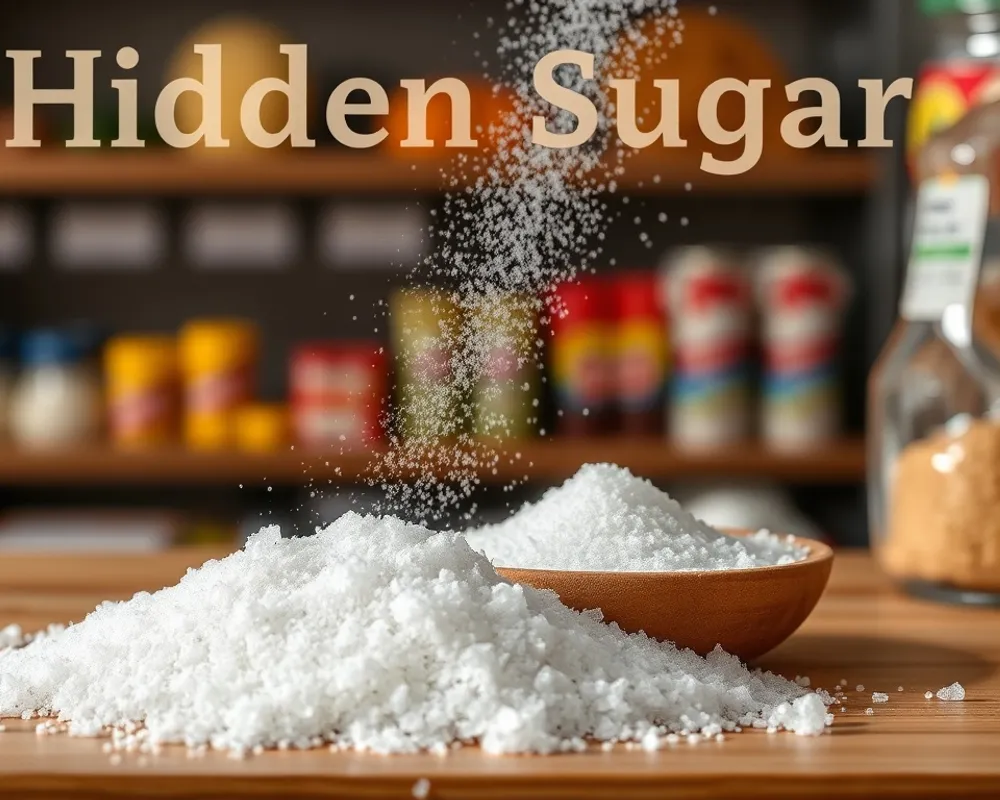
Sugar hides under more names than most people realize.
The FDA maintains a list of over 60 approved names for caloric sweeteners. Manufacturers use different names to avoid the word "sugar" appearing multiple times on the label. This is ingredient splitting in action.
Here are the most common aliases you will encounter:
- High-fructose corn syrup (HFCS)
- Maltodextrin
- Dextrose
- Sucrose
- Fructose
- Glucose
- Maltose
- Lactose
- Evaporated cane juice
- Fruit juice concentrate
- Agave nectar
- Honey
- Molasses
- Brown rice syrup
- Corn syrup solids
- Barley malt
- Malt syrup
- Invert sugar
- Cane sugar
- Beet sugar
Maltodextrin is especially sneaky. It is a highly processed starch derivative that spikes blood sugar faster than table sugar. It doesn't taste particularly sweet, so it flies under the radar in protein bars, sauces, and dressings.
Fruit juice concentrate is another common trick. It sounds healthy, but it is essentially sugar water with the fiber removed. Manufacturers add it to products labeled "no added sugar" because the sugar comes from fruit.
The FDA allows this.
If you are comparing products for your garden, the same principle applies. Check the actual composition, not the front-of-bag claims. You can compare organic and synthetic options in our article on compost vs fertilizer.
Trans fat the 0.5 gram loophole explained
The FDA allows manufacturers to list "0g trans fat" if the product contains less than 0.5 grams per serving.
This is one of the most deceptive loopholes on the label.
A product labeled 0g trans fat can still contain partially hydrogenated oil. If you eat multiple servings, you can consume a meaningful amount of trans fat without ever seeing it on the Nutrition Facts panel. The ingredient list is the only place it shows up.
Here is how to spot it.
| Label claim | What to check in the ingredient list |
|---|---|
| "0g trans fat" | Look for "partially hydrogenated oil" |
| "Trans fat free" | Check for "shortening" or "hydrogenated" |
| "No trans fat" | Verify no partially hydrogenated vegetable oil |
| "Reduced trans fat" | Look for interesterified fats (a newer substitute) |
The FDA determined in 2015 that partially hydrogenated oils are no longer Generally Recognized as Safe (GRAS). Manufacturers had until 2021 to remove them from the food supply. But products manufactured before that date can still be sold on shelves.
Some manufacturers have switched to interesterified fats as a replacement. These are chemically modified oils that don't contain trans fat in the traditional sense. But research on their long-term health effects is still limited.
If you see "partially hydrogenated" anywhere on the ingredient list, put the product back. Even a small amount per serving adds up over time. This is especially important for high-risk individuals with heart disease or high cholesterol.
For those maintaining their own equipment, checking the ingredient list on fuels and lubricants follows the same logic. You can learn more about proper maintenance in our guide on how to repair a lawn mower without a technician.