
When was the wheelbarrow invented? It’s a question that sparks curiosity about the origins of a tool so fundamental to moving materials that we often take it for granted. The simple design, featuring a single wheel, handles, and a basin, has been a workhorse for centuries, profoundly impacting construction, gardening, and agriculture.
While its ubiquitous nature suggests ancient origins, the exact timeline and place of the wheelbarrow's invention are subjects of historical debate. However, the evidence points to significant developments in China and medieval Europe, transforming labor-intensive tasks into manageable ones. Our research delves into these historical threads to pinpoint when this invaluable tool first appeared.
Unearthing the Wheelbarrow's Origins
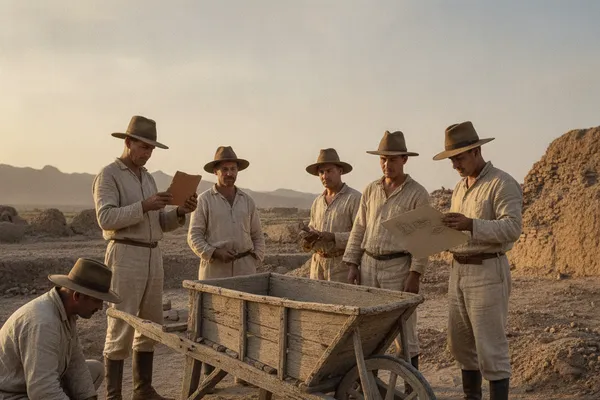
The wheelbarrow, a cornerstone of manual material handling, has a history that’s more complex than its simple appearance might suggest. Its invention wasn't a single eureka moment but rather an evolution that significantly eased human labor across various industries. Understanding its genesis helps us appreciate its enduring utility and the ingenuity behind it.
When Did the Wheelbarrow First Appear?
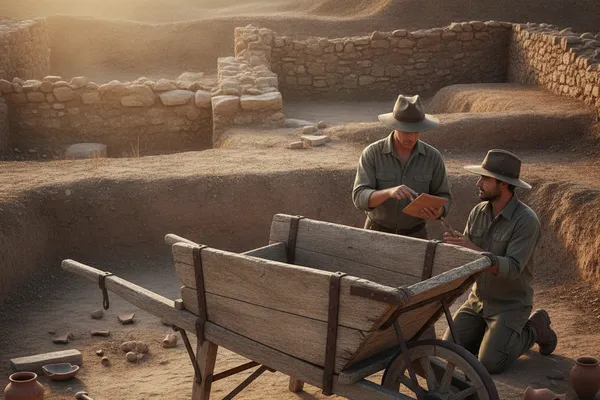
Pinpointing the precise date of the wheelbarrow's invention is challenging, as early records are scarce and often open to interpretation. However, scholarly consensus generally places its earliest verifiable origins in Imperial China. Archaeological evidence and textual references suggest that a form of wheelbarrow, likely a single-wheeled cart, was in use by the 2nd century AD. This early Chinese design was sometimes depicted with rear-mounted wheels, differing from the front-mounted wheel we recognize today.
Early Wheelbarrow Debates: China, Greece, or Rome?

While China holds strong claims for a very early wheelbarrow type, some historians have explored possibilities in ancient Greece and Rome. Texts from ancient Greece mention a single-wheeled carriage, but this is often interpreted as a handcart or a primitive wagon rather than what we typically recognize as a wheelbarrow. For the Roman Empire, there's little concrete evidence of a direct precursor to the modern wheelbarrow in common use for construction or agriculture. The concept of leveraging a single wheel for load-bearing efficiency appears to have developed independently or was adopted and refined elsewhere.
The Medieval Wheelbarrow: A Game Changer for Work

The wheelbarrow as we know it, with its characteristic forward-mounted wheel for better leverage and maneuverability, saw widespread adoption and refinement during medieval Europe, particularly from the 12th and 13th centuries onward. This period was crucial for innovations that supported growing construction projects, such as cathedrals and castles, as well as advancements in agriculture. The medieval design allowed a single laborer to move substantial loads more easily than before. This innovation drastically reduced the physical strain and increased the efficiency of tasks like moving earth, stone, and building materials.
How the Early Wheelbarrow Worked: Single Wheel Advantage
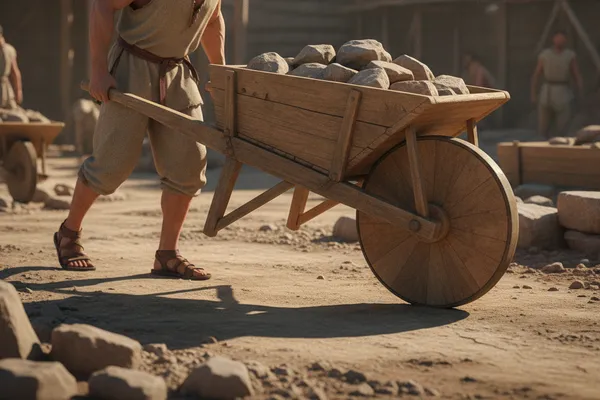
The fundamental principle behind the wheelbarrow’s effectiveness lies in its single-wheel design. This configuration allows the user to pivot the load around the wheel, acting as a fulcrum. By placing most of the load’s weight onto the wheel and using the handles for balance and propulsion, the user only needs to lift about one-third of the total weight. This mechanical advantage is key, transforming the task of moving heavy materials from an almost impossible feat of brute strength to a manageable effort of pushing and balancing.
Why the Wheelbarrow Was Invented: Solving Labor Pains
The invention of the wheelbarrow was driven by a clear need to reduce the immense physical labor required for transporting materials. In ancient times and the early medieval period, moving anything heavy, be it bricks, soil, harvested crops, or rubble, meant carrying it by hand, using baskets, or employing multiple people and simple sledges. The wheelbarrow offered a significant improvement by enabling a single person to carry far greater quantities of materials more efficiently and with less exertion. This innovation directly addressed the pain points of back-breaking work, improving productivity in construction, farming, and general labor.